Private dining at home: how to make an evening with your own chef work
Your own chef in the kitchen, the table laid, nobody needing to get up: private dining can make for a wonderful evening. How to plan it, what to ask and which mistakes to avoid.
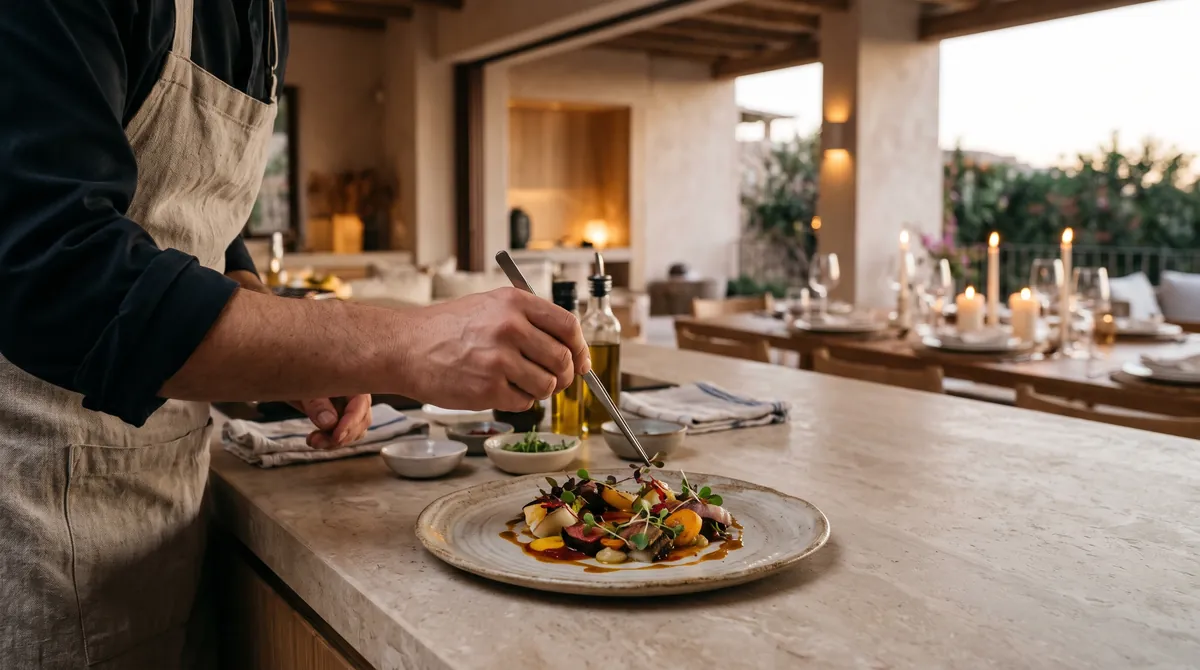

In the late afternoon the doorbell rings. The chef carries in two crates of vegetables, herbs and fish, along with a roll of knives and a bag of pans that have clearly seen a good deal of travel. An hour later the kitchen smells of brown butter and thyme, the table is laid and the candles are waiting. When the guests arrive, a first small amuse-bouche is ready, and all evening nobody has to get up to fetch anything. Private dining can be a wonderful experience. To make it a success, though, you need more than a good idea.
When a chef at home is the right choice
An evening with your own chef is especially worthwhile when being together is the whole point: a birthday or anniversary, a family gathering in a holiday villa, a dinner with business partners where discretion matters, or an evening with small children who go to bed early while the adults carry on eating in peace. With guests who follow particular diets, too, a chef who cooks only for that table is often more relaxed than any restaurant.
The format suits you less well if what you really want is a night out: the mood of a city, encounters with other diners, the view across a bustling dining room. Very large groups in small kitchens are a challenge as well, one that can only be met with extra staff and a simpler menu. And if you love standing at the stove yourself, a hands-on cooking evening will make you happier than a set menu.
The formats: from set menu to cooking evening
- Set menu with service: several courses served at the table, the classic and most elegant form.
- Family style: large platters and bowls in the middle of the table, everyone helps themselves, lively and convivial.
- Hands-on cooking evening: guests watch, ask questions, help with individual steps and then sit down to eat together.
- Fire and grill outdoors: on the terrace or in the garden, with fish, vegetables and meat cooked over the coals.
- Catering over several days: in a holiday villa, from breakfast to dinner, with a carefully planned menu for the whole week.
The brief: what the chef needs to know
The more thorough the initial conversation, the more relaxed the evening. A good chef will ask questions of their own accord, but it helps to put the key points in writing beforehand:
- The number of guests, their ages and whether children will be eating.
- Allergies, intolerances and dietary requirements, in writing and with names.
- The occasion and the mood you have in mind: festive, relaxed or with a surprise.
- Likes and dislikes, including the small ones, such as coriander, offal or very spicy dishes.
- Timings: when the guests arrive, the aperitif, the start of the meal and when you would like it to end.
- Drinks: who supplies the wine, will there be a wine pairing, and would you like an alcohol-free pairing?
- Equipment: which crockery, glasses and table linen are available, and what needs to be brought?
Checking the kitchen in advance
A good chef will ask about your kitchen before suggesting a menu. How many hobs are there, is it induction, how big is the oven and does it have a fan? How much room is there in the fridge, is there a dishwasher, enough worktop and good light? The way into the house counts too: parking, stairs, a lift and somewhere to set the crates down. Photos of the kitchen and a short list of the available appliances will save a good deal of back and forth.
In holiday houses it is worth checking the house rules or briefly asking the owner whether outside chefs are welcome and where the pans, baking trays and crockery are kept. Some kitchens look generous and yet are equipped for a holiday, not for a six-course menu for twelve guests. If you know this early, the menu can be adapted or missing equipment brought along.
Questions to ask before you book
Don’t compare quotes by the final total alone, but by what exactly is included. These questions bring clarity before you commit:
- Is the shopping included in the quote, or are the ingredients charged separately against receipts?
- Does a member of the service staff come along, and from how many guests is one needed?
- Who tidies up, washes up and cleans the kitchen, and when does the team leave the house?
- Is there proof of food hygiene training and public liability insurance?
- What are the cancellation terms, and what happens if the chef is unable to come?
- Are there sample menus, photographs or feedback from previous hosts?
Preparing the room
What the chef does not take on is up to you: the room. Lay the table in the afternoon, before the team arrives, so that the kitchen stays clear. Keep flowers low, so that guests can see one another across the table, and choose unscented candles that will not compete with the food. A place for coats, a corner for the aperitif and a clear path from the kitchen to the table help the service more than you might think. Dim the lights a little when the courses begin, and keep the music soft enough to carry the conversation rather than drown it out. If you are eating outdoors, think of blankets for cool evenings and lighting for the path.
How the evening unfolds
As a rule, expect the chef to arrive two to three hours before the meal, and earlier for an elaborate menu. During this time the kitchen belongs to them. Give them space, but stay within reach, for questions such as where the serving platters are. As the guests arrive, small canapés go round with the aperitif, followed by the courses at a pace you have agreed beforehand. If you are planning speeches, presents or surprises, let the team know, so that no course suffers while it waits.
At the end of the evening the kitchen will, ideally, be tidier than before. If you wish, leftovers will be packed and labelled, so that a small lunch is ready for the next day. A tip for the chef and service staff is customary if the evening has been a success, and, as in a restaurant, it reflects how satisfied you are.
The greatest luxury of the evening is not the menu, but the fact that nobody has to leave the table.
Common mistakes and how to avoid them
The most common mistake is an overambitious menu. Five carefully cooked courses make for a lovelier evening than ten that overwhelm the kitchen. The second is a late brief: an allergy mentioned only once everyone is at the table can hardly be handled well any more. Third, the atmosphere is often forgotten. Lighting, music, a seating plan and table linen to suit the occasion contribute as much to the evening as the food. And finally, the children: have something simpler cooked for them earlier, and the adults can enjoy their meal in peace later on.
Planning wine and drinks in moderation
One of the advantages of an evening at home is your own cellar. Discuss the wines with the chef early, so that the menu can be built around them, or ask for suggestions. A different wine for every course is not necessary; two or three well-chosen bottles often carry the evening better. Plan an alcohol-free pairing just as carefully, perhaps homemade lemonades, teas or juices, and put water in carafes on the table. That way every guest feels equally well looked after, whether they drink or not.
What our selection is based on
A thorough initial conversation
We recommend chefs who ask about the guests, the kitchen and the occasion before sending a quote. A chef who sends a standard menu without a single question is planning past your evening.
Transparent billing
Fee, shopping, service and cleaning should be listed separately, so that you can compare quotes fairly.
Hygiene and insurance
Proof of food hygiene and public liability insurance are, for us, a matter of course in any professional service.
A menu that suits the kitchen
A good menu is tailored to what your kitchen can do and to the number of guests, not to a picture from a restaurant.
Questions and answers
How far ahead should you book a private chef?
For ordinary dates a few weeks is often enough. For public holidays, New Year’s Eve and the high season in holiday regions, you should enquire considerably earlier, because sought-after chefs are quickly booked up. An initial conversation without a fixed date helps to lay the groundwork.
Does the chef bring crockery and staff?
That depends on the offer. Many chefs bring their own tools, while crockery and service staff often need to be arranged separately. Settle these points in writing beforehand, so that nothing is missing on the night.
How many guests is private dining suited to?
A set menu with one chef and one member of service staff works particularly well for six to twelve guests. Larger groups need more staff and usually a simpler menu that can be well prepared in advance. For two people the format is especially personal, but, relatively speaking, also especially elaborate.
Go deeper in our network
- gourmarisThe gourmet restaurant guide
The gourmet restaurant guide introduces kitchens and culinary signatures that will inspire menu ideas of your own for an evening at home.
- LaxaryFashion, beauty, food and design
The magazine for fashion, beauty, food and design offers ideas for the table, for your role as host and for the right style for the evening.
Finest.Lifestyle selects by its own criteria. The images are AI generated illustrations and do not show specific houses or products.