Style on deck: what to wear sailing on Lake Constance
On the lake the weather turns quickly, and a wooden deck forgives no wrong sole. How to dress on board in a way that is both practical and classic.
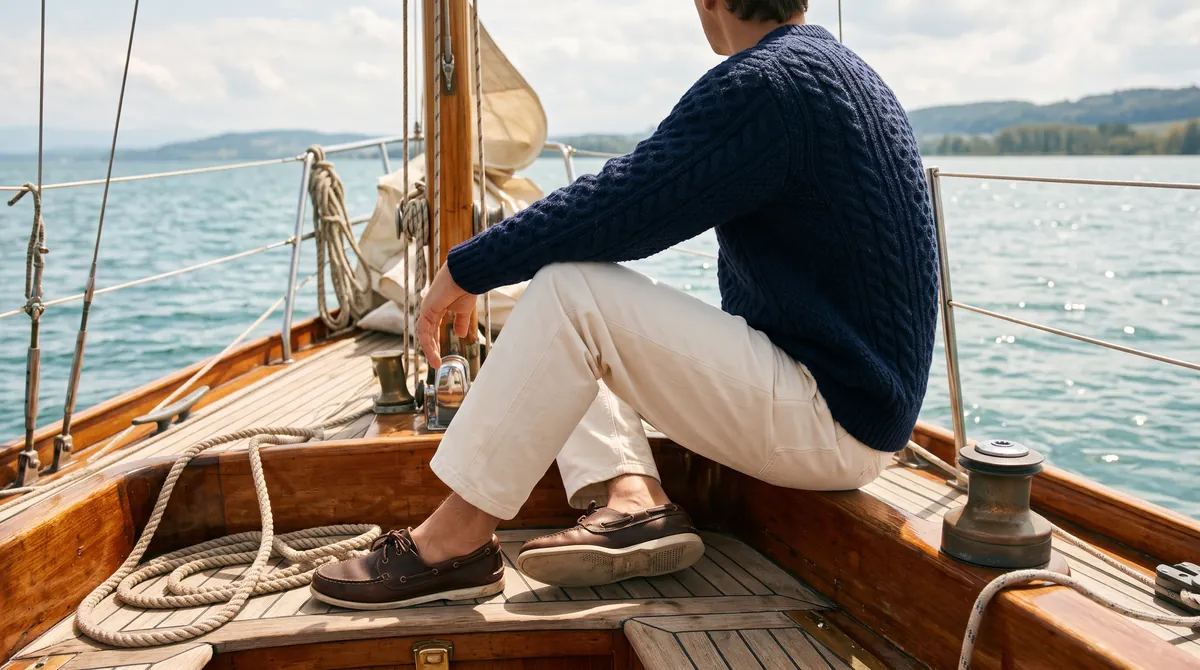

Early in the morning a thin haze still hangs over the harbour at Lindau, and the masts are mirrored in the water. At the jetty a wooden boat is waiting, its mahogany freshly varnished, its lines neatly coiled. Before the skipper invites his guests aboard, his gaze drops to their feet, to their shoes. It is a small gesture, yet it says a great deal about sailing on Lake Constance: what counts here is what works, and beauty follows from getting it right. Come aboard suitably dressed and you will enjoy the day more, whether the wind dies away entirely or begins to freshen.
Why the lake has rules of its own
Lake Constance is an inland water with a view of the Alps, and its weather is more capricious than many expect. On hot summer days thunderstorms build in the afternoon, bringing strong wind and rain within a short time. Föhn conditions send warm, gusty winds down from the Alps, while on calm days there is barely a breath of air for hours. Around the shore, orange flashing lights warn of strong winds and storms; the faster they flash, the more serious the situation. For your clothes this means being prepared for both: for sun with dazzling reflections and for a drop in temperature within half an hour.
One advantage over the sea: the water is fresh. The salt crusts that stiffen leather and cotton at sea do not form here. On the other hand, the lake is still cool in early summer, and if you get wet you will feel the chill sooner than you would like.
Layering on board
Sailing clothes for a day on the lake follow the layering principle. Several thin layers can be put on and taken off as the wind and sun change, and together they keep you warmer than a single thick garment.
- Base layer: a T-shirt in cotton or, better still, fine merino wool, which stays warm even when damp; the classic is the striped Breton top, which has its origins in the navy
- Mid layer: a jumper in pure new wool, such as a zip-neck jumper whose collar shields the throat from the wind, or a densely knitted fisherman’s jumper
- Outer layer: a windproof, water-repellent sailing jacket with a hood and a collar that closes high
- Below: chinos in sturdy cotton twill or shorts in a quick-drying fabric, and full-length trousers in spring and autumn
Wool has a special place on board. Untreated new wool contains lanolin, on which water simply beads, and it keeps you warm even after catching some spray. Cotton, by contrast, grows heavy when wet and leaves you cold. That is why a good knitted jumper accompanies many sailors for decades, becoming a little more personal with every summer. When buying, look for densely knitted, boiled or tightly twisted qualities; loosely knitted fashion jumpers simply let the wind through.
The sole decides
On a wooden deck, shoes are not a question of style but of safety and respect for the boat. Classic deck shoes have a pale, non-marking rubber sole with fine, razor-cut grooves that grip on wet surfaces. The upper in oiled leather copes with spray, and the leather lace that runs all the way round can be tied firmly. Black or heavily treaded soles leave streaks on teak and varnish, and small stones lodge in deep treads and scratch the deck. On some boats people sail barefoot or in socks anyway; ask before you step aboard what the skipper prefers.
After a day on the water, dry wet leather shoes slowly, stuffed with newspaper and away from radiators or blazing sun. A conditioning oil for leather keeps the material supple, so that it does not crack on your next outing.
On a wooden boat the skipper’s first glance rarely falls on your shirt, and almost always on the soles of your shoes.
Classics with good reason
Much of what is now considered nautical style has a practical origin. Navy and white are hard-wearing, combine endlessly and still look neat after a day in the wind. The high collar of the zip-neck jumper protects the neck, and the hood of the sailing jacket keeps off the rain without blocking your view. A cap or a hat with a cord stays on your head even when the boat tacks, and sunglasses with polarised lenses reduce the glare off the water; secure them with a glasses strap. If you lend a hand with lines and winches, you will be grateful for sailing gloves that are open at the fingertips and preserve your feel for the rope.
Read the weather, choose your clothes
What you wear depends on the day’s weather. The overview serves as a guide for the season from May to September. If in doubt, pack one extra layer: on the water it is usually a few degrees cooler than on the shore, especially when the wind sweeps across the open lake.
| Weather | What to wear | What to keep within reach |
|---|---|---|
| Sunny summer’s day, light wind | Long-sleeved linen or cotton shirt, shorts, cap | Sunglasses on a strap, water bottle |
| Changeable early summer day | Merino top, zip-neck jumper, long trousers | Sailing jacket with a hood |
| Humid day with a risk of thunderstorms | Light merino or technical clothing that does not chill you when wet | Jacket and a dry shirt in a waterproof bag |
| Evening sail | Knitted jumper, long trousers, socks | Beanie or scarf for the trip back |
What goes in the sailing bag
Luggage for a day on board should be soft. Hard cases and bags with metal feet have no place on a boat: they slide around, scratch the wood and cannot be stowed. Far better is a duffel bag or a bag in coated sailcloth that folds flat. Inside go a dry shirt to change into, the knit for the evening, your jacket, a towel, something for your head and a bottle of water. A small waterproof pouch protects your phone and keys in case a wave does wash over the deck. Leave room for sun protection too, because on the water the reflection makes the sun stronger than it feels in a cool breeze.
A little etiquette for guests on board
As a guest on someone else’s boat, a few small gestures will win you goodwill. Arrive on time, because wind and weather wait for no one, and ask in advance whether you should bring anything. Step aboard only once the skipper invites you, and board at the point he shows you. Apply your sun cream on the jetty rather than on deck, because greasy traces make wood slippery and leave marks on the varnish. Do not step on coiled lines, keep your hands and feet clear of winches and cleats as long as you do not know what they are being used for, and it is better to ask once too often. Red wine and dishes with tomato sauce are best left ashore. And anyone who helps tidy up after mooring, coiling the lines, stowing the cushions and rinsing the deck, can count on being asked along next time.
From jetty to harbour restaurant
On Lake Constance a day’s sailing often ends on a harbourside terrace, in Constance, Meersburg or Bregenz. It takes no great change of clothes: fresh chinos, a clean shirt in linen or Oxford cotton and loafers instead of deck shoes, and the nautical day becomes an elegant evening. For women, wide linen trousers, a navy blouse or a knitted dress work just as well, with flat sandals or leather ballet flats. The only thing to beware of is dressing up in costume. A captain’s cap, anchors on every piece and rope for a belt quickly look like fancy dress. The most beautiful harbour style is the kind that has clearly been worn on board.
What our selection is based on
Grip on deck
Pale, non-marking soles with a grooved tread protect both you and the boat. For us, this is the first question to ask of any shoe.
Warmth when wet
Wool and merino keep you warm even when damp. Cotton alone is rarely enough on the lake.
Protection from wind and weather
A jacket with a hood and a high collar decides whether a thundery shower is an adventure or an ordeal.
Freedom of movement
Working the lines means stretching and bending. Tight cuts and stiff fabrics get in the way on board.
Classic without costume
Nautical details should have a reason. We prefer pieces that look equally natural on board and ashore.
Questions and answers
Do I need special sailing clothes as a guest?
Not for a day trip. Comfortable clothes in layers, a warm jumper, a windproof and water-repellent jacket and shoes with pale soles are enough. Specialist technical clothing is worth it only if you sail regularly or in rough weather.
Can I go barefoot on deck?
On some boats this is usual and even welcome, because it spares the deck. Bare feet are more slippery, though, and do not protect your toes from fittings. Ask the skipper what applies on board, and have your deck shoes with you.
When is the best time to sail on Lake Constance?
The season generally runs from May to September, often into October. In early summer the water is still cool, and in high summer afternoon thunderstorms are more frequent. Late summer often brings settled days with pleasant temperatures.
What should I do when the storm warning flashes?
The decision lies with the skipper, and usually the boat heads briskly for harbour. For you this means putting on your jacket, stowing loose items and following the instructions on board. If your jacket has been within reach from the start, you are at a clear advantage at that moment.
Go deeper in our network
- valcaniFashion, jewellery and watches
For more on classic wardrobes, knitwear and shoes with heritage, turn to the magazine for fashion, jewellery and watches.
Finest.Lifestyle selects by its own criteria. The images are AI generated illustrations and do not show specific houses or products.


