Design objects that give a room personality
A lamp, a vase, a chair with a story: how to choose, combine and display design objects so that a room looks like you rather than a catalogue.
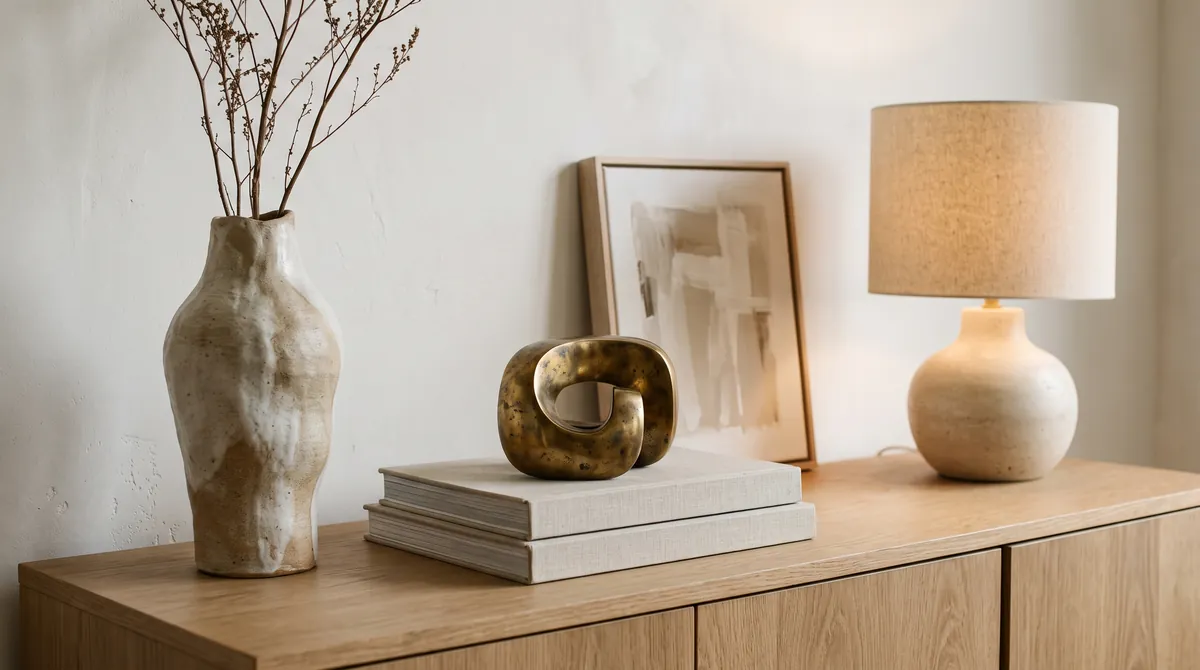

You walk into a flat and within seconds you know who lives there. Not because of the size of the rooms or the sofa, but because of a single object: a paper lamp floating above the dining table like a small moon, a glass vase with a wavy outline on the windowsill, an armchair of leather and wood that has clearly been in use for decades. Personality rarely comes from many things, but from a few that have been chosen with care. This guide shows how to find such objects and give them their rightful place.
What makes a design object
Not every beautiful thing is a design object in the strict sense. What is meant are pieces in which form, function and material have come together in a convincing solution, often so convincing that they remain in production for decades. Isamu Noguchi’s Akari lamps of washi paper and bamboo, Alvar Aalto’s glass vase with its undulating outline, the Lounge Chair by Charles and Ray Eames, the Arco arc lamp by the brothers Achille and Pier Giacomo Castiglioni: each of these pieces tells of an idea and of the time in which it was created. That is why, decades later, they look not dated but entirely natural.
For your rooms, this means a design object need not be famous. It can just as well come from a small workshop: a hand-thrown bowl, a stool in solid wood, a lamp from a young studio. What matters is that it has a clear point of view, that you share that point of view, and that you will still enjoy looking at it in ten years’ time.
The anchor piece first
Rooms with character almost always have an anchor piece: an object that draws the eye first and by which everything else takes its bearings. It might be an armchair, a large lamp, a table with an unusual top, a rug with a bold pattern. Choose this piece first and deliberately, then arrange the rest around it. Work the other way round, searching for something special at the very end, and you will rarely find anything that truly holds its own.
One anchor piece per room is enough. Two rival stars, say a sculptural lamp and a striking armchair right next to each other, cancel each other out. Spread strong pieces across different zones or rooms instead, and keep the furniture in between deliberately quiet: a simple sofa, a plain table, shelving without flourishes.
Scale, spacing and groups
The most common reason beautiful things fail to make an impression is the wrong scale. A small vase on a long sideboard disappears; a lamp that is too large overwhelms a low room. Hold objects up in their future place before you buy, or recreate their outlines in cardboard. Spacing counts too: an object needs air around it to be read as a form. When you arrange things into a group, on a chest of drawers or a shelf, for example, a few simple rules help:
- Varied heights: one tall element, one medium, one low. That creates a line the eye can follow.
- A unifying element: a colour, a material or a shape that holds all parts of the group together.
- Contrasts in material: gloss beside matt, glass beside wood, smooth beside rough.
- A frame: a tray, a stack of books or a picture on the wall above that gives the group a point of reference.
- Empty space: leave around a third of the surface free. Only the emptiness makes the group legible.
Material and provenance
Objects with personality usually have a material you can feel: ceramics with visible throwing marks, mouth-blown glass with small irregularities, patinated brass, solid wood with an open grain, leather that darkens over time. Surfaces like these change with light and use, and so remain interesting. Plastic imitations and flawless high gloss, by contrast, soon look interchangeable.
With classics, it is worth looking at provenance. Many famous designs are still made under licence today, while copies of every quality circulate alongside them. You can recognise an original by its markings, its documentation and the quality of its workmanship. A well-preserved piece from earlier decades may also have a patina that a new production only achieves after many years. Examine second-hand classics closely before you buy: frame, upholstery, cover, electrical parts and whether spare parts are available.
Where to find objects with a history
The finest pieces are seldom found on a first shopping trip. Dealers in twentieth-century design, auctions specialising in furniture and lighting, well-stocked flea markets and house clearances are rich sources, but they demand patience and a trained eye. New work can be discovered at design fairs, on open workshop days or at the exhibitions of design schools, where young designers show their first pieces.
Do not buy to stockpile or simply to fill a gap. Acquire an object only because there is still room on the shelf, and you fill the room instead of shaping it. It is better to leave a spot empty for a while until the right piece turns up. Note down the dimensions of the key spots in your home, so that you can decide quickly when you are out and about.
Light as a stage
An object is only as good as the light that falls on it. A sculptural vase against a wall with side lighting shows its form; the same vase under a ceiling spotlight looks flat. Use table lamps, small wall lights or a carefully angled spot to model a piece. The rule: from the side and slightly above rather than head-on, and warm rather than cool.
Lamps themselves are often the strongest design objects in a room, because they work twice over: as a form by day and as a source of light by night. A paper lamp changes its character completely the moment it is switched on, and a brass lamp casts golden reflections onto the wall. So plan for both, the look by day and the effect by night.
Personality rarely comes from many things, but from a few that have been chosen with care.
Mixing across eras
Rooms drawn entirely from one era soon feel like an exhibition. The mix is more exciting: a classic modernist chair at an old farmhouse table, a piece of contemporary ceramics beside an inherited silver candlestick, a tubular steel cantilever chair of the kind the Bauhaus produced in a period flat with plaster mouldings. The connection comes through material, colour or attitude, not through the year a piece was made.
Movement is just as important. Rearrange objects from time to time, put some away for a season and bring others out. A room that changes gently stays alive, and you see your things again and again with fresh eyes. Many people only rediscover a long-overlooked piece once it stands in a different place.
What stands in the way of personality
Too many small things that together look like dust traps. Objects bought only because they are suddenly everywhere. A display so perfect that no one dares to pick anything up. And classics that stand around as status symbols instead of being used. A design object is at its most beautiful when it is part of your everyday life: when you read in the armchair, work under the lamp and eat from the bowl. Signs of use are not a flaw but proof that a thing has found its place.
What our selection is based on
Clarity of idea
A recommended object must have a recognisable point of view: a form that solves a task convincingly.
Material and workmanship
We favour pieces whose surface grows more interesting with use, and we look for clean, skilled craftsmanship.
Provenance
With classics, licensed production or documented provenance is what counts. We do not recommend copies.
Effect in the room
Scale, light and surroundings decide whether an object lends a room personality. That is why we never judge a piece on its own.
Questions and answers
How many design objects can a room take?
There is no fixed number. A helpful rule is to choose one anchor piece per room and let the other objects take a back seat. If you no longer know where to look when you walk in, it is too much.
Is an original worth it compared with a copy?
An original is usually markedly better in material, workmanship and proportion, and holds its value better. Then there is fairness towards designers and manufacturers. If the budget will not stretch, an independent piece from a small workshop is a better choice than a copy.
How do I combine heirlooms with modern design?
Look for a link through material or colour, such as dark wood, brass or a recurring glaze. Give the heirloom a place of its own with light and air, rather than squeezing it in between new things.
Go deeper in our network
- glaminiaDesigner lighting
Designer lamps in portrait, from modernist classics to new designs that shape a room by day and by night.
- arisanoArt and aesthetics
Aesthetics and inspiration around objects, art and design, with a look at the ideas behind the forms.
Finest.Lifestyle selects by its own criteria. The images are AI generated illustrations and do not show specific houses or products.


