A weekend by private jet: when it really makes sense
Away on Friday afternoon, back on Sunday evening, with no changes and no long queues. When a private jet makes sense for a weekend, which class suits you and what to ask before you book.
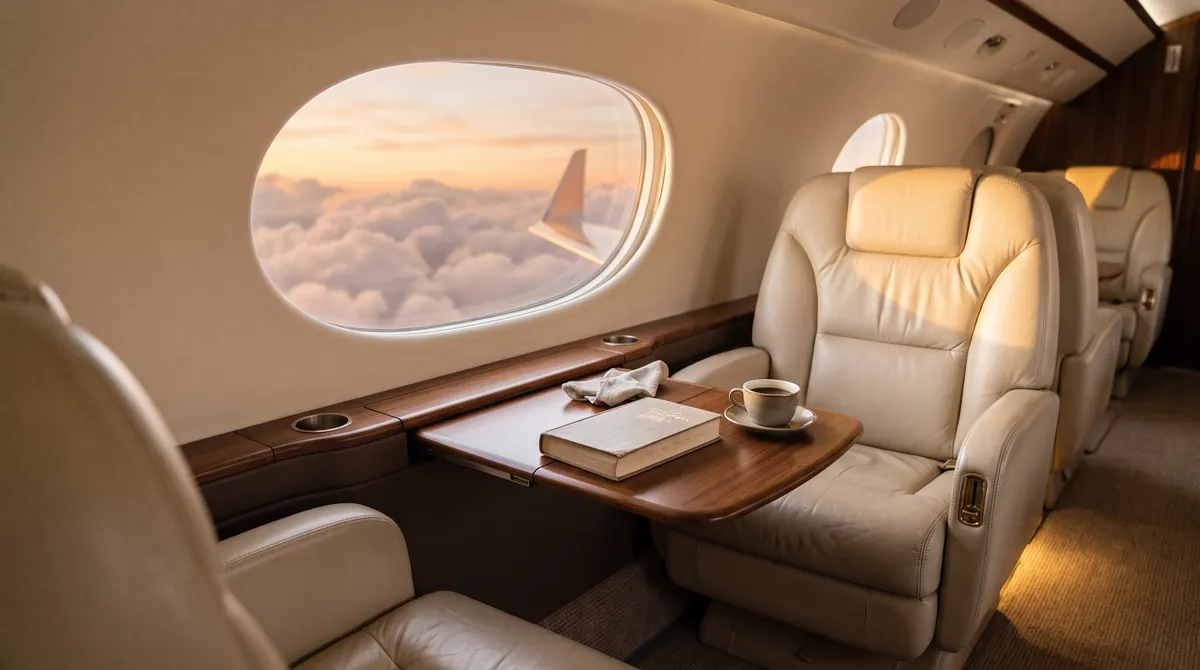

Friday, just after three. Instead of passing through security with hundreds of other travellers, you walk through a small terminal where a coffee is already waiting. Out on the apron the aircraft stands with its steps lowered, and the luggage is loaded while you take your seat. A good hour later you touch down somewhere no scheduled flight reaches directly. That is the promise of the private jet. Whether it keeps that promise for a weekend depends less on the aircraft than on the route, the size of the group and the planning.
When a private jet comes into its own
Above all, a private jet saves time, and it does so in places you barely notice when you fly scheduled: on the journey to large airports, in waiting, in changing planes, on the long trip from the arrival airport to where you actually want to be. This is most obvious on routes without a good direct connection, or when a small airfield lies right by your destination while the nearest major airport is far away.
- Destinations without a direct flight: Where the scheduled route means changing planes, the jet often saves half a day.
- Small airfields close to your destination: An airfield in the mountains or on the coast spares you long transfers.
- Groups of four to eight: The costs are shared, and everyone travels together.
- Several stops: If you want to combine two places in one weekend, the jet keeps you flexible.
- Special luggage or pets: Skis, golf bags or a dog in the cabin are often easier to arrange, depending on the operator and the destination country.
A private jet makes less sense on well-connected routes with short journeys to major airports, for solo travellers over long distances, or when the destination can in any case only be reached via an airport that also handles scheduled flights and where distances are short. Then the time saved is small, and the effort is out of all proportion to the benefit.
Aircraft classes at a glance
For a weekend in Europe, smaller jets and turboprops are the main options. The classes differ in range, cabin size and luggage space. The choice should follow the route and the number of guests, not a desire for size. On short routes a turboprop often arrives barely later than a jet, because it can use shorter runways closer to the actual destination.
| Class | Typical for | Bear in mind |
|---|---|---|
| Turboprop | Short routes, short runways, islands and mountains | Slower than a jet, often very flexible at small airfields |
| Very light jet | Two to four guests, shorter routes | Little luggage space, often only a basic toilet |
| Light jet | Four to six guests, many destinations in Europe | A cabin for sitting, barely for standing, limited luggage |
| Midsize jet | Six to eight guests, longer routes | More cabin height and luggage space, needs longer runways |
| Super midsize and larger | Larger groups, long routes | Often more than you need for a weekend in Europe |
A rough guide. Capacity and range depend on the specific aircraft type and its load.
Empty legs and the logic of costs
When you charter a jet, you don’t just pay for the flights you are sitting on. If the aircraft is not based at your departure airport, the positioning flight there is often charged as well. For a weekend, a second question arises: does the crew stay at the destination until you fly back, or does the aircraft return empty and collect you again on Sunday? Both cost money, and how much varies with the route and how busy the operator is.
Empty legs, as the trade calls them, are the flip side of this logic. When an aircraft has to fly somewhere without passengers anyway, some operators offer that flight at a lower price. For a spontaneous weekend this can be tempting. The catch: the date, time and route are fixed, and if the original client moves their flight, the empty leg may be cancelled. For a fixed date or an important occasion it is therefore not a reliable basis.
An empty leg is a lovely gift of chance, but no basis for a fixed date.
Airfields that lengthen the weekend
The real advantage often lies on the ground. Many regions have smaller airfields or dedicated terminals for general aviation, where distances are short and procedures quick. In the Engadine, Samedan airfield is just a few minutes from the villages in the valley; on the Côte d’Azur, Cannes-Mandelieu is geared to business aircraft. Such airfields often come with their own conditions, though: short runways, demanding approaches in the mountains, limited operating hours or noise rules. Some require special crew briefings or only accept certain aircraft types.
So don’t just ask whether a flight is possible; ask too whether the aircraft offered is suitable for the airfield you want and what restrictions apply, for instance in wind, in snow or after dark. In winter, de-icing in the mountains adds time that should be built into the plan.
Weather, winter and a plan B
Private jets don’t fly in all weathers either. Fog, snow or strong crosswinds can make small airfields temporarily inaccessible, while large airports with better approach aids can still be used. A good operator will therefore name an alternative airfield for every destination and plan the transfer from there at the same time. Especially on winter weekends, when many people are heading for the mountains, it pays not to schedule the outbound flight in the last hours of daylight. Leaving at Friday lunchtime rather than in the evening costs half a working day, but often secures the whole of Saturday.
Questions that matter before booking
- Are you the operator of the aircraft yourselves, or are you brokering the flight to an operator?
- Does the operator hold an approval for commercial passenger flights?
- Which aircraft type, which year of manufacture and which cabin configuration are planned?
- Are the positioning flight, crew waiting time, fees, de-icing and catering included in the quote?
- How much luggage really fits in the hold, including skis or golf bags?
- What happens if there is a technical problem: is there a replacement aircraft?
The question about the approval is no mere formality. In Europe, commercial flights with paying passengers may only be operated by companies holding the appropriate licence. Avoid offers that are strikingly cheap and leave it unclear who is actually flying. A reputable broker will name the operator before you book.
How a weekend unfolds
On the day of departure it is usually enough to be at the terminal shortly before take-off; the company will tell you how much time you need. You still need your passport or ID, even within the Schengen Area, and your luggage is checked, albeit more quickly. On board a small jet, the comfort is more like that of a very good car than a living room: comfortable leather seats, a small table, drinks and food ordered in advance. Knowing this, you won’t be disappointed. Pushchairs, child seats and sports equipment should be declared beforehand so that the loading can be planned.
On the way home, flexibility pays. One great advantage of a private jet is that the departure time can be pushed back if Sunday is too beautiful to cut short. The limits are set by the crew’s duty hours, the airfields’ operating hours and any night-flying restrictions. Ask in advance how much leeway there is.
An honest assessment
Ultimately, a private jet is a good choice for a weekend when it gives you time that would otherwise be lost, and when the group is large enough to justify the effort. That is often the case for families with small children, for groups of friends celebrating together, or for couples who want to spend two days somewhere hard to reach. If, on the other hand, you simply want to travel a little more comfortably, a good scheduled connection with a short transfer is often the more sensible solution.
What our selection is based on
Time saved, not prestige
We recommend a private jet only where it genuinely saves hours, not as an end in itself.
The right aircraft class
Size, range and luggage space must suit the route and the group. Bigger is not automatically better.
Transparent quotes
A good quote names the operator, the aircraft type and all additional costs, including positioning and waiting time.
Licensed operators
We only advise flying with operators approved for commercial passenger flights.
Questions and answers
From how many people is a private jet worth it?
There is no fixed threshold. As a rule, the costs are noticeably shared from four people upwards, and on routes with a long scheduled journey even with fewer. What matters is how much time you save compared with a scheduled flight.
What is an empty leg?
A flight that an aircraft would have to make without passengers anyway. Operators sometimes offer it at a lower price. The date and route are fixed, however, and the flight may be cancelled if the original booking changes.
Do I need ID on a private flight?
Yes. Travel documents are checked on private flights too, within the Schengen Area as well as on flights to other countries. The procedures are usually quicker, but the obligations are the same.
Can my dog come in the cabin?
With many operators this is possible, often even for larger dogs. However, the entry rules of the destination country apply, and some operators or aircraft do not accept animals. Clarify this before booking.
Go deeper in our network
- jetchaPrivate jet charter explained
There you will find a step-by-step explanation of how private jet charter works, from the first enquiry to landing.
- rolaviaPrivate jets and helicopters
If you would like to compare aircraft types, helicopters and charter formats, you will find in-depth background there.
Finest.Lifestyle selects by its own criteria. The images are AI generated illustrations and do not show specific houses or products.


